Sunday, 8 May 2016

Poem: Out of the Mire of Despair

     I haven't written a poem in a long time. I've started on a few but cannot seem to finish them. Perhaps reading great poetry has exposed my poetic inadequacies and I am caught in a fear of failure - a sickening mental paralysis. The past week was tough, but when I really left my house for the first time in a week yesterday, I saw (what I think are) tulips growing on the outside of the wall. I've never really been one who appreciates flowers, but they caught my eyes - bright yellow and red. And I remembered another tulip, rather TULIP and slowly I found words. 

     2 Corinthians 4: 1-6 has been one of the most significant passages that taught me what grace looks like, and how one should respond to it. Here's verse 6 (perhaps my favourite Bible verse) before you read the poem: 'For God, who said, "Let light shine out of darkness," has shone in our hearts to give the light of the knowledge of the glory of God in the face of Jesus Christ.'

Out of the mire of despair,
The Lord has lifted me.
He, whose image I had impaired,
Has heard my hopeless plea.

Far from my flashes of constancy,
The Lord, His word has kept.
Convulsed in rebellious ecstasy,
This being is sunk in debt
To unrighteous consistency -
The payment – yet – strangely met.

For the Curse was pronounced its doom
In tomes of ancient time;
A man would bear weak Adam’s doom,
A swap for humankind.

Then into the midnight of my soul,
My Lord has shone his light;
Evinced in wounds whence a crimson flow
Surely cured sin’s deadly blight.

Friday, 15 April 2016

Book Review: The Gospel - Ray Ortlund

     The full title of this book is The Gospel: How the Church Portrays the Beauty of Christ. And the subtitle is important to understand Ray’s point. He wants to show how gospel doctrine creates a gospel culture – and all that is to display Christ’s beauty.

     Thus, in this short book, Ray seeks to show the gospel implications for the individual, the (new) community (of believers) and the cosmos. These are the first three chapters of the book which provide the theological framework for the next four chapters.

     In chapters 4 – 7, Ray fleshes out what it looks like to ‘do church.’ He is realistic. Thus, he warns of suffering, of discouragement, of difficulty; at the same time he shows readers that because God is building His church, there is the joyful certainty that if the gospel is at the church’s ‘sacred centre,’ it can gradually become the community God designed it to be.

     Ray writes with great humility, gently showing us the folly of Christian self-trust (which, if we are honest with ourselves, is almost always the case), and pointing us to the glories of Christ’s gospel. This book is a call for churches to enjoy the gospel once more if we have lost sight of it, and to behold its beauty every day, because we can never get enough of it. It is also an encouragement and challenge for Christians to live passionately for the gospel.

     He quotes Francis Schaeffer ‘if we do not show beauty in the way we treat each other, then in the eyes of the world and in the eyes of our own children, we are destroying the truth we proclaim.’ And we can only show that kind of beauty if we have tasted, and are daily devouring the beauty of the gospel.

     I know my church needs a truly gospel culture. I don’t think I will suddenly love my fellow Christians in a drastically different (and better way), but this book has pointed out to me what I must do if I want to love better – be gripped by the gospel. So if you want to love the church better, I’d say this gem of a book is for you.

Tuesday, 12 April 2016

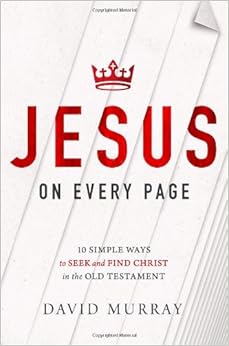
Book Review: Jesus On Every Page - David Murray

     In this book, David Murray’s objective is to help readers find and enjoy Jesus when reading the Old Testament. He states it clearly that “many books did not help the reader start to do his or her own Christ-centred interpretation… the practical steps that would help a reader get from a text or chapter to Jesus were often missing. I’ve therefore tried to provide templates and step-by-step guides … to help the reader start practicing this wonderful way of enjoying Jesus in His Word” (p. 2).

     What follows is a very readable account of his own journey to find Jesus in the Old Testament (Part 1) and 10 ways to find Him in the OT (Part 2). This book is not academic; it has, instead, a very pastoral focus – to elicit our worship of Jesus. Thus, the tone is very personal, but there does seem to be weaknesses in many of his arguments. I think he sacrifices some scholarly depth for accessibility. This would be my major criticism of the book.

     Here are the 10 ways he proposes that readers can find Jesus in the Old Testament:
1)    Christ’s planet: Creation
2)    Christ’s people: OT Characters
3)    Christ’s presence: Christophanies
4)    Christ’s precepts: Law
5)    Christ’s past: OT history
6)    Christ’s prophets: Prophets
7)    Christ’s pictures: OT types
8)    Christ’s promises: Covenants
9)    Christ’s proverbs: the Proverbs
10) Christ’s poets: Poems

     This passage captures Murray’s theological framework: “We all believe the same gospel. The vocabulary was different, the clarity was different (Abraham believed in the shadows; we, in the sunlight), and the direction was different (Abraham looked forward to Jesus, whereas we look back), but the core, the essence, the focus was the same” (p. 16). From this starting point, he brings readers on a journey to discover Christ in the OT, providing very helpful tips and pointers with regards to methodology.

     Each chapter is great, but I found the ones on the Law and the prophets most helpful. However, I sometimes found it difficult to follow his thoughts within certain chapters. Perhaps because the book reads more like a conversation than an essay, I had to pause once in a while to try to figure out the relevance of some of his points.

     Although I do not agree with everything he says, this has been a helpful resource and a great introduction to finding Christ in the Old Testament because of its pastoral emphasis. This however, isn’t really a textbook on Biblical Theology. Thus, I would recommend this resource to anyone wishing to read the Old Testament to enjoy Jesus, but is unfamiliar as to the ‘how’ question. On a similar note, for someone who wants to see how the whole Bible fits together, I would recommend Vaughan Robert’s ‘God’s Big Picture’ as an excellent introduction.  

Sunday, 10 April 2016

Book Reflection: Church History in Plain Language – Bruce L. Shelley

     Shelley notes that ‘surely one of the most remarkable aspects of Christianity today is how few of these professed believers have ever seriously studied the history of their religion.’ I definitely belong to this category, and I certainly regret not studying the history of Christianity earlier.

     What Shelley sets out to do in this book is to chart the development of Christianity from Jesus till the modern age (my edition is published in 2008, so up to that point). He attempts to do so by telling stories of people rather than merely stating cold hard facts. This writing style makes this crash course in Christian history very readable and accessible. Furthermore, there is no cost to the level of research and scholarship. Admittedly, he cannot explore people and incidents in great depth, but he is clear that his purpose is to do a general survey of the history of Christianity – a sort of appetiser to get us excited about learning more.

     Another feature of the book worth mentioning is the way he structures the chapters. He suggests large epochs:

1)    The Age of Jesus and the Apostles (6 BC – AD 70)
2)    The Age of Catholic Christianity (70 – 312)
3)    The Age of the Christian Roman Empire (312 – 590)
4)    The Christian Middle Ages (590 – 1517)
5)    The Age of the Reformation (1517 – 1648)
6)    The Age of Reason and Revival (1648 – 1789)
7)    The Age of Ideologies (1914 - )

     Under each age, he talks about significant people, movements and events that have shaped Christianity during those eras. Chapter lengths are manageable and quite neatly divided, so top points for organisation!

     Perhaps the only negative thing I have to say about the work is that there is certainly more focus on Western Christianity. We do not hear much about the Orthodox Church; neither do we read much about Christianity in Southeast Asia and Australia. But these complaints could be just me being greedy.

     I’ve definitely learned a few lessons and have been confronted with some questions. Through reading the book, I’ve become more aware of the Christian tradition that I now find myself in. By better understanding its roots, I’ve come to realise that this position – Reformed Evangelical Anglicanism - is quite a minority one. And it is humbling and somewhat scary; humbling in that I need to learn to be more tolerant and appreciative of the diversity of Christian traditions, and asserting I am right (even if I am right) in the hopes of convincing everyone else is already a failed historical experiment. So I definitely hope to be quicker to listen when someone speaks about Christianity differently, and try to understand the backgrounds and presuppositions that have shaped his doctrines and practices.

     And it is scary because for me this raises the question of truth: either some Christians are wrong, or nobody is right. The latter cannot be true, so it has to be the former. But what would that look like? Who determines who’s wrong and right? Protestantism would say take Scripture as the highest authority, but so many denominations claim to do so, yet interpret and apply things so differently. In other words, is there a single way to be Christian, or to do Christian ministry? These are, for me, nagging unanswered questions.

     However, Shelley argues that one thing unites all Christians – the Person Jesus Christ – and I wouldn’t dare disagree. Perhaps methodology may differ, perhaps there is a ‘better’ way of doing things. But what’s likely more important is that people are turning to Christ in repentance and faith and seeking to live under his lordship until he returns, all to God’s glory. I can see a picture of that in the international community here at Christchurch Durham. There’s a Brethren and some Methodists (this is, unfortunately not too diverse a group, but I think it illustrates my point), and though I disagree with many things they believe in, I am unashamed to call them brothers and sisters in Christ and to be ministers of the gospel together. Maybe, just maybe. (Also, I’ll try to ‘convert’ them in the process, haha! XD)

     I remember an illustration our student pastor uses to talk about Christian unity. He talks about planting the gospel flag in the ground, and all who run to it – those are who we will be united with. Sounds pretty similar to what Jesus says in Matthew 12:49 ‘And stretching out his hand toward his disciples, he said, “Here are my mother and my brothers! For whoever does the will of my Father in heaven is my brother and sister and mother.”’

Thursday, 24 March 2016

The Christian's Ode to Joy

This is arguably the best talk I've heard on the issue of not feeling what I know to be gospel truths. 


Don't listen to ourselves; talk to ourselves, for truth lies outside of us - in God's Word. 

Friday, 18 March 2016

"What is Literature?" - A Peek

     Let’s start with this quote from Tony Bennett: ‘the uniqueness of ‘literature’ consists in its tendency to ‘defamiliarise’ experience.’

     Thus, the simple answer to the proposed question is this: literature is any work which causes us to think and feel anew – that is, experience something as though for the first time. Well, admittedly, this doesn’t sound smart, nor does it sound complicated – but I think it is really important. Let’s explore why.

     Almost 100 years ago, a smart guy from Russia called Viktor Shklovsky identified a problem in his society. He quotes Leo Tolstoy who says ‘if the whole life of many people is lived unconsciously, it is as if this life had never been.’ Shklovsky chillingly elaborates, saying that ‘this is how life becomes nothing and disappears. Automatization eats things, clothes, furniture, your wife and the fear of war.’

     Two words are worth exploring: ‘unconsciously’ and ‘automatization.’ What Shklovsky has in mind is that once an experience is repeated - and in our age, so many things are on repeat – it becomes a habit, and routine actions become automatic. For example, I was lost during the first few days of my arrival in Durham and everything looked fresh and new. Now, after having lived here for almost a year and a half, I’ve lost the initial feelings I had when I first experienced the city. Now, I ‘recognise’ things instead of ‘see’ things. In other words, we are being routinely desensitised to life; ours is a numbed existence where we embark on a wild goose hunt for success and dreams, only to find waiting at the end of the rainbow – the sniggering face of Death.

     Literature then, is that which ‘restores the sensation of life, in order to make us feel things, in order to make a stone stony.’ This re-sensitising us to ‘the sensation of life’ is achieved primarily through ‘defamiliarisation.’ This simply means that we describe things differently. I’d like to take a look at this short story a friend (Clarissa, who blogs here) wrote, called ‘AlternateFrequencies:’

"There are many differences between him and her: skin colour, bank balance, number of years they have carried on their shoulders. They travel in alternate frequencies, destined not to meet.

Everyday at 3.15pm, however, he would wait outside her school door, the hot sun pressing down upon him. The beads of sweat slide agonizingly on his forehead like the condensation of his sugar cane drink.

There she is. Her designer schoolbag on her back, her latest iPhone, the heavy textbooks she carries with one hand – all reminders of the dissonance between him and her. Her eyes cut across the after-school din to meet his.

She approaches him, and gets inside the backseat of the car (not his). He revs up his engine and drives.

And finally silence settles.

All the other drivers told him he was lucky, he was paid so well. All her classmates told her it was good she was driven around. But no one saw the tragedy of the silence. 

They travel in alternate frequencies. They cannot, do not, make conversation."

     In her recounting the scene of a driver escorting his employer’s daughter home from school, Clarissa draws attentions to the disparity between the two characters – whose lives, though vastly different, intersect in a seemingly mundane moment. This ability to capture the imagination, I believe, lies in the disinterested narrator’s careful attention to details. For, although we see a lot of things: the waiting driver, the schoolbag, the iPhone and etc.; and we hear equally much: the after-school din, the revving engine, the voices of other drivers and classmates – there is finally and ultimately, an alienating silence.

     I believe many of us have witnessed scenes similar to this, but have never felt moved like we would have when reading the short story. There is nothing inherently significant about the story. Its effectiveness in communicating emotions is achieved simply by defamiliarising our habitualised perception. Thus, returning to our quotation at the start: ‘the uniqueness of ‘literature’ consists in its tendency to ‘defamiliarise’ experience,’ we begin to see how unpretentious, yet powerful this tool of defamiliarisation can be.

     This, is what I would consider the ‘literariness’ of a text: its ability to make one see and experience life.


PS: I hope I have not misread Clarissa’s short story. XD

Tuesday, 1 March 2016

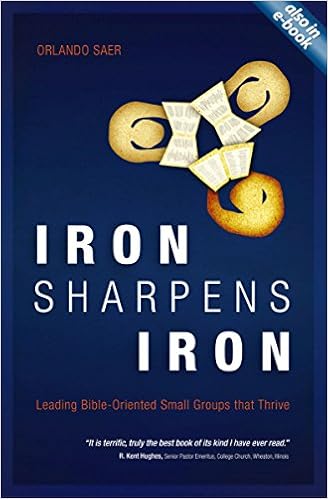
Book Review: Iron Sharpens Iron - Orlando Saer

     This is a great resource on how to lead a small group Bible study. The chapters are:

          1) Why Small Group Bible Study?
          2) Preparing for Leadership
          3) Managing the Group
          4) Mapping Out the Study
          5) Leading the Meeting
          6) Prayer, Care and Personal Nurture

     The book length is manageable, and each chapter has robust content despite being quite a short 
book.

     Saer's thought moves from the importance of small group Bible study to consider the nitty-gritties of actually planning, managing and leading the group. He provides practical tips with clear Biblical foundations.

     The book is written from experience and that comes across in the issues - dangers, challenges, realities - of small group study and is thus very helpful for anyone in such a leadership position. The book is also accessible to Christians who are not leaders - it offers a glimpse of what gospel-centred ministry looks like and I believe would help readers be better small group members.

     However, the book is not a comprehensive guide to leading a Bible study and Saer offers a list of further readings at the end of the book. Nevertheless, this book is a very helpful introduction to this topic and if someone asked me for a book on how to lead a small group, I would definitely recommend this - perhaps because this is the only book I've read on the topic. Regardless, I've found it immensely beneficial, especially in how he ably crystallises the foundations of and tips for leading a good small group Bible study.