Showing posts with label biblical theology. Show all posts

Friday, 28 October 2016

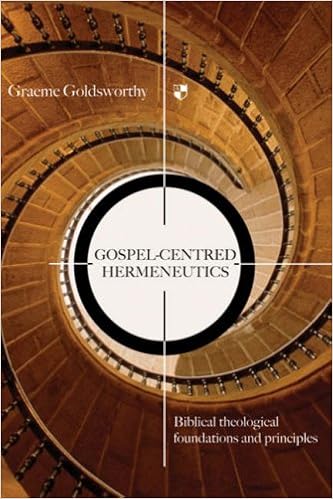
Book Reflection: Gospel-centred Hermeneutics - Graeme Goldsworthy

Since being introduced to biblical theology about three years ago, I have been passionate about studying it and encouraging others to see its importance. However, articulating why it is important often eludes me. I know that it affects how, as Christians, we read our Bibles - and therefore how we live as Christians. But when questioned, I often flounder trying to find a good reply.

Reading Graeme Goldsworthy's Gospel-Centred Hermeneutics: Biblical-theological Foundations and Principles (ISBN: 978-1844741458) has been extremely helpful in enabling me to evaluate my own presuppositions. I have learned the supporting arguments underlying important Evangelical hermeneutical axioms, been challenged by blind spots, and been exposed to further questions related to the practice of Biblical interpretation. These have helped me to form a clearer 'frame of reference,' or 'worldview,' or - using the name of this blog - construct a better set of 'gospel lenses' through which I perceive the world and understand reality in light of the Ultimate Reality - Jesus Christ. 

The book is tough to read. I started reading it sometime in June, but only just finished it. Perhaps it is because I am asking questions about how to read and understand at this point of time, that the book is particularly pertinent. Nevertheless, I would still highly recommend this book to anyone wanting to understand Goldsworthy's approach to biblical theology. I must say that I would largely associate myself with his version of the discipline - at least for now. 

Right, but going back to my first point about the importance of biblical theology for the life and health of the church, Goldsworthy sounds a clarion call: 
The main hermeneutical goal is the relating of the text to the person and work of Jesus Christ. This necessitates consideration of all the dimensions of the biblical revelation, and especially biblical theology. I cannot stress too much how important biblical theology is to the process of understanding and applying the Bible. It should be taught to children at home and in Sunday schools. It belongs in adult Bible groups, and it should be intentionally preached from the pulpits. Above all, it should be a required course in every theological seminary and Bible college. Biblical theology provides the link between any part of the Bible and its centre in Christ. This is an essential perspective for valid application of ancient texts to modern readers and hearers. Even those texts, especially in the New Testament, that are written specifically as directions to Christians, are derivative of the place of Jesus Christ in the scheme of things (p. 312, italics mine).
Goldsworthy is also very articulate here
Gospel-centred hermeneutics is above all the endeavour to understand the meaning of any aspect of reality, including the Bible, in the light of him who is the Light of the World (p. 315).
For him, Christ is the interpretive key to everything. I agree, and I pray that his Spirit will enable me to do so, to the glory of God the Father.

Sunday, 31 July 2016

Some thoughts on confusing Bible passages - Matthew 27: 51-53

     I believe in the perspicuity (clarity) of the Bible. And though there are passages (or maybe even books) whereby Evangelicals might defer with regards to interpretation, Evangelicals largely agree on core Gospel issues. Nevertheless, I would like to spend some time considering (what I would regard as) ‘confusing’ Bible passages and offer some thoughts about them. Here I discuss Matthew 27: 51-53.

     Here are vv.51b-53: “And the earth shook, and the rocks were split. The tombs also were opened. And many bodies of the saints who had fallen asleep were raised, and coming out of the tombs after his resurrection they went into the holy city and appeared to many.

     This description is unique to Matthew’s Gospel, and I have thought it very strange. And yet, I have yet to come across a satisfactory explanation as to why ‘the bodies of the saints … were raised.’ This could not be some kind of pre-Easter resurrection, yet the text is clear and unambiguous. Then I came across Ezekiel 37:12-14. I quote snippets from it: “Thus says the Lord GOD: Behold, I will open your graves and raise you from your graves, O my people… And you shall know that I am the LORD, when I open your graves, and raise you from your graves, O my people.” (Please also read the passage in full.) I think the language is similar, so perhaps Matthew is making reference to this passage in Ezekiel, saying that Jesus’ crucifixion is the fulfilment – or the moment – that God fulfils His promises stated in Ezekiel 37 and its larger context. Generally speaking, the promise is that God will restore the nation of Israel and make a new covenant with them.

     This opens up the possibility that what Matthew wrote did not ‘literally’ happen (this is controversial, I know, but bear with me). It could be that when Matthew looked at the events surrounding Jesus’ death and resurrection, and looked back at the Scriptures, he found that Jesus fulfilled the promises, or inaugurated their fulfilment. Thus, he applies Ezekiel’s vision to Jesus’ death, showing to his (likely) Jewish audience that Jesus is the answer to the vision God gave to Ezekiel.

     But our Bible reading should never be for dry theological knowledge, and so I’d like to consider some implications of reading this passage this way. Firstly, I think that would help us think more deeply about the significance of the cross. I think too often in Evangelical, gospel-centred circles, we read books or sermons about the death of Jesus and think that it’s only about penal substitution. I understand the emphasis, but there is so much more there that I think we will discover if we allow ourselves to dig deeper and ask more questions. This, I think would help us appreciate Jesus’ crucifixion more and increase our wonder at our God who works out all of His promises through His Son – allowing us to rejoice even more greatly in the salvation He has graciously given.  

     Secondly, this might encourage us to read our Old Testament even more closely. Over the past few years I’ve been introduced to Biblical Theology, and I’ve come to see the richness of the Old Testament as part of God’s redemptive revelation. I believe we cannot properly understand the Old Testament without the New, and vice versa. And rooting the New Testament in the Old is grounding it in the overall sweep of redemptive history, avoiding an ‘a-temporal, philosophical’ Christianity that I find to be quite prevalent.

     However, there are many more issues to consider, like the context of this passage – especially how Matthew reads and uses the Old Testament. Another potentially problematic are would be the question of whether things happened exactly as Matthew writes it. Another legitimate worry is that I am making things up and going too far with how I use the Bible. Regarding the third concern, I hope to gradually consider more passages and write about the Biblical Theological methods that I’m employing, so that people can read and judge for themselves. I’m no Bible scholar, but I firmly believe a layperson can understand Scripture and I believe that we don’t need to get a certificate in theology before we can read our Bibles well. I’m embarking on a journey of discovery, so join me if you are interested.  

     Also, if anyone reading this has thoughts, do feel free to share them in the comments. 

Thursday, 2 June 2016

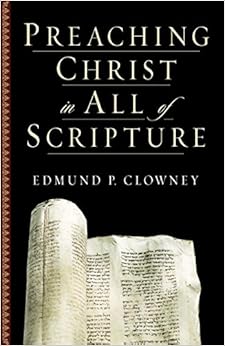
Book Review: Preaching Christ in All of Scripture - Edmund Clowney

     Clowney says in the preface that the chapters are ‘[…] sermons are offered as messages to be heard as preaching, not as footnoted theses for study’ (p. 10). Thus, the book is not so much about how to preach Christ in all of Scripture, but a few examples of how one can go about it. The first two chapters do provide some kind of theoretical framework, but I thought the content could have been organised better.

     So here are the chapters:
1)    Christ in all of Scripture.
2)    Preparing a sermon that presents Christ.
3)    Sharing the father’s welcome (Luke 15: 11-32).
4)    See what it costs (Genesis 22: 1-19).
5)    When God came down (Genesis 28:10-22).
6)    The champion’s strange victory (Genesis 32).
7)    Can God be among us (Exodus 34:1-9)?
8)    Meet the captain (Joshua 5:13-15).
9)    Surprised by devotion (2 Samuel 23:13-17).
10) The Lord of the manger.
11) Jesus preaches liberty (Luke 4:16-22).
12) The cry of the God-forsaken saviour (Psalm 22:1).
13) Our International Anthem (Psalm 96:3).
14) Jesus Christ and the lostness of man.
15) Hearing is believing: The Lord of the Word.

     These sermons are written to elicit praise, and so his language is beautiful and his points quite easy to follow. Almost every chapter ends with a call to see afresh God’s grace to His people in Christ throughout redemptive history, and as such, the book can be read as a devotional.

     The aspect of the book I find most helpful is Clowney’s ability to draw lines of connection from Old Testament events, figures or objects to Christ. He does so quite carefully, although I found some of his readings somewhat arbitrary, and leaning slightly towards allegory. But overall, he models good interpretive practices, always paying careful attention to the redemptive-historical character of the Bible.

     All in all, the book is not an academic treatise on the topic, but a pastoral exhortation to see and savour Christ in all of Scripture. 

Sunday, 10 January 2016

Biblical Theology for kids

     This looks to be a promising resource for teaching children about the Bible. I don't think we can accuse Biblical Theology of being 'too academic.' 


Thursday, 29 January 2015

Book#3 The Theology of the Book of Genesis - R. W. L. Moberly

          I grew up with the vague idea that somehow the Old Testament and the New Testament were related. They had to right? Because they are in the Bible, and if they were not connected, why place them together? Then I was introduced to the idea of Biblical Theology, which argues that the Bible has a unified story: God progressively working to redeem his people, his actions culminating in the Person and Work of Jesus. Another important understanding is that because God’s revelation is progressive, Jesus’ coming changes the way we look at certain things in the Old Testament.

          I adopted this approach as I read the Old Testament, which in practice meant that many characters and scenes had typological significance instead of having a more general moralistic application. Also, the link between the Old and the New Testaments became more firmly established. For example, the story of David and Goliath is often applied as challenging and encouraging us (the readers) to be like David in trusting in God to defeat adversity. However, according to Biblical Theology, we are the Israelites, trembling and helpless against the enemy, and David is a type of Christ. His act of saving the Israelites points to Jesus’ act of saving humankind from sin.

          However, this might present problems (of which I hope to engage more in a separate post), one of which is (I think) this: that we are reading into the text (specifically the Old Testament) meanings that were not intended by the original authors. Vaughan Roberts suggests that ‘we need to let each Old Testament passage speak in its own right before we consider how it points to Christ1.’ So I think that as I try to understand an Old Testament passage and attempt to make its connection to Christ, I need to seriously engage with the text, in its contexts, on its own terms.

          Sorry for the delay but I finally reach my main point. I think that Prof. Moberly (he is my Old Testament module lecturer) does precisely that in his book The Theology of the Book of Genesis (ISBN: 9780521685382). He looks specifically at Genesis, starting with a broad overview of its literature and how one approaches the book, then focuses on passages that have been hotly debated. What characterizes his work is that he does not force his own interpretations on the reader. Instead, most chapters first examine the views of other scholars on the discussed passage and then offers a different viewpoint before presenting Moberly’s own understanding of the text.

          He writes the book from an academic framework, albeit constructed within a Christian frame of reference – something different from what I was previously exposed to. Thus, reading this book is akin to being part of a theological discussion on Genesis. We as readers are practicing theology, which he defines as ‘not a once-for-all exercise in finding the right words and/or deeds, but rather a continuing and ever-repeated attempt to articulate what a faithful understanding and use of the biblical text might look like in the changing circumstances of life’ (p. 19).

          In a gentle way, he challenges us to look beyond our presuppositions, to suspend the preconceptions we always have towards something (in this case the Bible or a particular passage in it) and engage with the text on its own terms. Certainly my understanding of Genesis has been somewhat altered, and more questions have to be asked. I am now less certain about the theology of Genesis but I do not think it is an issue.

          Now, problematic or seemingly insignificant material can be heuristic in any Christian’s attempt to understand Genesis, and consequently, the Bible. We just need to ask the right questions.
1. Vaughan Roberts, God’s Big Picture (Nottingham: IVP, 2009), p. 165.