Friday, 28 October 2016

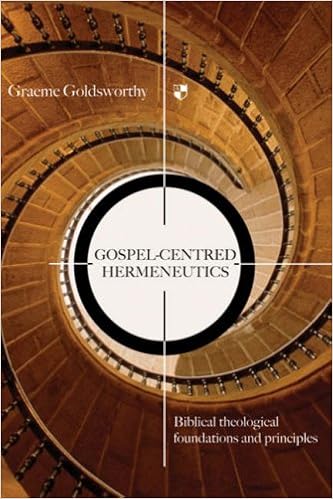
Book Reflection: Gospel-centred Hermeneutics - Graeme Goldsworthy

Since being introduced to biblical theology about three years ago, I have been passionate about studying it and encouraging others to see its importance. However, articulating why it is important often eludes me. I know that it affects how, as Christians, we read our Bibles - and therefore how we live as Christians. But when questioned, I often flounder trying to find a good reply.

Reading Graeme Goldsworthy's Gospel-Centred Hermeneutics: Biblical-theological Foundations and Principles (ISBN: 978-1844741458) has been extremely helpful in enabling me to evaluate my own presuppositions. I have learned the supporting arguments underlying important Evangelical hermeneutical axioms, been challenged by blind spots, and been exposed to further questions related to the practice of Biblical interpretation. These have helped me to form a clearer 'frame of reference,' or 'worldview,' or - using the name of this blog - construct a better set of 'gospel lenses' through which I perceive the world and understand reality in light of the Ultimate Reality - Jesus Christ. 

The book is tough to read. I started reading it sometime in June, but only just finished it. Perhaps it is because I am asking questions about how to read and understand at this point of time, that the book is particularly pertinent. Nevertheless, I would still highly recommend this book to anyone wanting to understand Goldsworthy's approach to biblical theology. I must say that I would largely associate myself with his version of the discipline - at least for now. 

Right, but going back to my first point about the importance of biblical theology for the life and health of the church, Goldsworthy sounds a clarion call: 
The main hermeneutical goal is the relating of the text to the person and work of Jesus Christ. This necessitates consideration of all the dimensions of the biblical revelation, and especially biblical theology. I cannot stress too much how important biblical theology is to the process of understanding and applying the Bible. It should be taught to children at home and in Sunday schools. It belongs in adult Bible groups, and it should be intentionally preached from the pulpits. Above all, it should be a required course in every theological seminary and Bible college. Biblical theology provides the link between any part of the Bible and its centre in Christ. This is an essential perspective for valid application of ancient texts to modern readers and hearers. Even those texts, especially in the New Testament, that are written specifically as directions to Christians, are derivative of the place of Jesus Christ in the scheme of things (p. 312, italics mine).
Goldsworthy is also very articulate here
Gospel-centred hermeneutics is above all the endeavour to understand the meaning of any aspect of reality, including the Bible, in the light of him who is the Light of the World (p. 315).
For him, Christ is the interpretive key to everything. I agree, and I pray that his Spirit will enable me to do so, to the glory of God the Father.

Tuesday, 25 October 2016

Reflecting on Truth and Historicity (I)

Since starting my English degree in Durham, one of the biggest issues that has challenged my trust in the Bible is the issue of its historicity. Dictionary.com defines the word as ‘historical authenticity.’ And here’s a line from Wikipedia: historicity focuses on the truth value of knowledge claims about the past (denoting historical actuality, authenticity, and factuality).

I remember reading Henri Blocher’s In the Beginning. He suggested that the literary approach to reading the creation account in Genesis 1 is the best, because it is the method that seeks to understand the Bible on its own terms. In other words, since the Biblical author was not concerned about (modern) scientific questions, reading Genesis 1 for scientific truths is anachronistic (and I would suggest – eisegetic). Perhaps we can find scientific truths in the Genesis account, but if the goal of Biblical interpretation is finding out what the Author/author intended, and how to live in light of that intention, then I am happy to read the creation account in a non-literalistic way. I am not discounting (most) other interpretations, but how we approach Genesis 1 is an indication of our hermeneutical presuppositions.

Let us ask this question: what makes the Biblical account of a historical event true? Many Christians I know and respect will reply that historicity is an essential element. However, modern Christians have a modern understanding of history. We equate history with fact. I think this imposition of modern standards of historiography on Biblical narrative should be questioned – did the Biblical authors share our view of historiography? I am inclined to say ‘no,’ although I will have to read up more. But I agree with the gist of Robert Gundry’s point here:

“I do not deny that events reported in the Bible actually happened, but only that the Biblical authors meant to report events, or historical details in connection with events, at points where Geisler and others think they did so mean. I deny in some texts what would be the literal, normal meaning for a reader who assumes a modern standard of history-writing, but not what I believe to be the literal, normal meaning for the original audience, or even for a modern audience that is homiletically oriented.”1

Here are two more quotes from Goldsworthy’s Gospel-Centred Hermeneutics:

“Attempts at harmonising the Gospels, it seems to me, have usually ignored the way history has been narrativised” (p. 232).

I think the key idea here is narrativised history.

“[…], while there are grey areas in which evangelical opinions over the historical truth claims may differ (e.g. ‘Is Job historical or parabolic?’ ‘Is Jonah a factual missionary story?’), the preaching of such as historical fact is only problematic when the concern for historicity overshadows the concern for the theological message. Some of Jesus’ parables may well be drawn from real life, but their significance does not depend on their being ‘historical.’ The same may be said (cautiously) of Job. The issues, then, is not whether we can accept only what can be tested by scientific historical means, but what relationship the narrated events bear to the gospel. In one sense the history/fiction debate is important to remind us that history writing in ancient times was creative in a way that was not calculated to be deceptive. The crafting of accounts that some may call fiction is not designed to reduce the historical value, but to emphasise it” (p. 232-33).

I lean towards Goldsworthy’s willingness to accept that significance (or truth) does not depend on historicity. I will readily admit that if I do not proceed with caution, I can easily stumble onto the path of liberalism. But I do not think that fear should stop Christians from thinking seriously about the Bible.


1. Robert Gundry, “A Surrejoinder to Norman L. Geisler,” Journal of Evangelical Theological Society 26, no. 1 (March 1983): 113-14, quoted in Five Views on Biblical Inerrancy.  

Monday, 10 October 2016

Some Thoughts on Horton's Review of Wright's book

Michael Horton raises a few important issues in this book review

1) Modern misunderstandings about the gospel abound. The gospel divorced from history (the Old Testament) becomes just another philosophical thought. Hence, the importance of Biblical Theology. 
The traditional presentation of the gospel—e.g., the “Romans Road”—has little contact with the story the apostle is telling in that famous epistle, Wright argues. Abstracted from the story of Israel, the gospel becomes reduced to “Jesus bore God’s wrath in your place so you could go to heaven when you die.” That old-time religion had some legitimate pieces of the puzzle, but it didn’t put them together properly. Consequently, evangelicals have moralized the problem (sin merely as violations of a code), paganized the solution (an angry Father punishing his Son), and platonized the goal (going to heaven when we die).

 2) There's more to the cross than Penal Substitution. Many evangelicals say this, but for us, it is practically only about how propitiation. I understand the concern to be clear in the face of increasing denial (even among Christians) of this aspect of the cross, but we risk moving to the other extreme of the spectrum.

3) The intermediate state.
Finally, I have some questions about Wright’s solution to the “platonized” eschatology. Here as well, his criticisms of the whole Christian tradition are sweeping, encompassing the Reformation as well. However, these same critiques have a long history in Reformed theology. Luther pledged to put Origen “back under the ban” for his Platonic speculations, and no one emphasized more than Calvin the significance of Christ’s glorified humanity as the guarantee we will be raised bodily to share in a renewed creation. Harman Bavinck, Geerhardus Vos, Herman Ridderbos, John Murray, Meredith Kline, Richard Gaffin, and others showed me the differences between Plato and Paul. In fact, some, like G. C. Berkouwer, overreacted against “Platonism” by denying the intermediate state altogether—which Wright, happily, is careful to avoid. But what do we do with the passages that teach, explicitly or implicitly, a distinction between heaven and earth?  
I am currently reading a book about the relationship between Israel and the Church. One aspect of the discussion touches on our theology of the end times. I am an ammillenialist, and one thing we emphasise is inaugurated eschatology, in simpler terms, the already-but-not-yet aspect of Christian eschatology. Perhaps the implications of this issue for the average Christian is not glaringly direct, but how we view eternity (and therefore the present) will certainly shape how we live today. 

Wednesday, 5 October 2016

Writing is Difficult

I spent the whole morning writing a blog post on my two months back in SMACC 2, then spent the early part of my afternoon contemplating taking the post down.

Despite making every effort to watch my tone and examine my purpose and motivation for writing, I feared that what I wrote could be taken wrongly. I cannot explain away that feeling of unease, so I guess it was better to take the post down.

And so I conclude that writing is difficult. Although it is what I spend most of my time doing now, there is a weighty responsibility to anyone wishing to have words permanently inked on paper – in this instance – the treacherous sea that is the internet.

Sometimes I wonder if the mental exhaustion of writing well is worth experiencing. But then again, when we do catch those glimpses of the ineffable, it makes the previous sufferings worth it. This reminds me of what Paul said in 2 Corinthians 4:17 ‘For this slight momentary affliction is preparing for us an eternal weight of glory beyond all comparison…’ (I am not interpreting the verse, I am drawing an analogy.)

For now, I guess I should just keep working at articulation.  

Monday, 3 October 2016

Thinking about Feelings

It is strange how our feelings are often beyond our control. Naturally, we cannot help but feel angry when we are offended or see injustice; we cannot help but feel sadness when we are hurt, or the people around us are; we cannot help but feel joy when something goes right for us or for people we care for. I believe this is true for most of us – unless we put in great amounts of effort to suppress our emotions.

I am currently feeling somewhat sentimental. Being back in Durham has been great – I have managed to catch up with a few friends, but I am also aware that for a few people I said goodbye to three months ago, our paths may never cross. And at the back of my mind, there is that one person – that I am hoping beyond hope – I would not have to say a permanent goodbye come June next year.

My rational mind cannot convince my feelings to halt its descent into self-destructing infatuation. So in a light-hearted spirit of hopelessness, here’s a poem I would like to share about ‘the one that got away.’ This poem is written by W.B. Yeats. It is pretty straightforward, except for the identity of ‘Love’ and the ‘he’ in the final stanza.

But this is not an essay, it is an avenue to articulate the various threads of thoughts which entangle my mind. So here’s the poem:

When you are old and grey and full of sleep, 
And nodding by the fire, take down this book, 
And slowly read, and dream of the soft look 
Your eyes had once, and of their shadows deep; 

How many loved your moments of glad grace, 
And loved your beauty with love false or true, 
But one man loved the pilgrim soul in you, 
And loved the sorrows of your changing face; 

And bending down beside the glowing bars, 
Murmur, a little sadly, how Love fled 
And paced upon the mountains overhead 
And hid his face amid a crowd of stars.

What should I do now then? Definitely not wallow in the self-constructed prison of my feelings. I believe the gospel has power to save and redeem every part of us – including these emotions. I have not figured out how to deal with this issue, I readily admit I am lost. However, I am sure that I need not despair, I will trust in my saviour as he leads me day by day to face the evil without, and the darkness within. 

Friday, 5 August 2016

Reading through Romans - Romans 1:1-7

     I’ll be studying the book of Romans later this year when I head back to Durham, so I thought I should read it through now and write about it – because writing helps me articulate my thoughts. I hope to be posting up my thoughts on short passages as I’m going through the epistle, since it is a relatively long one. I’ll try to keep my references to external resources limited, and focus on observation. Hence, what follows are my thoughts rather than definitive interpretation. (Also, I’ll be making reference to the ESV version, and I’m still practising my paragraphing.)  
---
     Paul uses ‘called’ three times in this passage (v1, 6, 7) – the first time referring to himself, with the latter two referring to the Romans – in regards to belonging to Christ. Knowing that ‘calling’ can be a tricky term which is overused in modern Christian circles, it would be interesting to see how Paul develops this idea throughout the book.

     In verses 2 – 4, Paul expands on ‘the gospel of God’ (v1). It consists of two main ideas: 1) this gospel was ‘promised beforehand through his prophets and in the holy Scriptures;’ 2) it concerns his Son. Regarding point 1) it will be worth paying attention as to how Paul fleshes out this idea. About 2), Paul then chooses to highlight two aspects of the Son: 1) he was ‘descended from David according to the flesh;’ 2) he was ‘declared to be the Son of God in power according to the Spirit of holiness by his resurrection from the dead.’ We have two ‘according to’ and they seem to be contrasting – ‘flesh’ vs ‘Spirit.’ I’m not sure what ‘flesh’ means at this point, perhaps Paul will develop this idea later in his epistle.

     A few interesting ideas in v4 hinge on Jesus being ‘declared to be the Son of God […] by his resurrection from the dead,’ – we could ask: in what sense is this statement true? Was Jesus not already the Son of God prior to his resurrection? And what is the Spirit’s role? I don’t have answers, but I suspect they are somewhere in the Old Testament (perhaps Psalm 2?).

     Verse 5 picks up from v3 ‘concerning his Son,’ where Paul tells the Romans that grace and his apostleship are from Christ, and that his purpose is to ‘bring about the obedience of faith for the sake of his name among all the nations.’ So the missionary’s job description according to Paul here is 1) elicit ‘obedience of faith’ and 2) for Jesus’ global glory. Paul doesn’t explain what kind of obedience this is, so we’ll have to wait. With regards to point 2, this echoes the OT theme of people knowing God (cf. Isaiah 49:26; Ezekiel 36:38 as examples).

     To conclude an already brief post, Paul establishes the nature of his apostleship (commission, content –‘the gospel of God’ – and purpose) to Roman Christians. Everything seems to centre on Jesus Christ. An obvious takeaway would be that Christ must be the centre of any gospel message, because God’s gospel is concerning his Son. I think it was Greidanus was said that it’s not enough that our sermons be God-centred, they must be Christ-centred. That’s striking and I know not everyone will agree. Also, another important point is that this gospel is not about us; it is ‘for the sake of [Christ’s] name among all the nations.’ It is easy to shift the focus of the Christian message from being Christ-exalting to people-exalting, especially in our narcissistic culture. Let’s not fall into that trap.  

Sunday, 31 July 2016

Some thoughts on confusing Bible passages - Matthew 27: 51-53

     I believe in the perspicuity (clarity) of the Bible. And though there are passages (or maybe even books) whereby Evangelicals might defer with regards to interpretation, Evangelicals largely agree on core Gospel issues. Nevertheless, I would like to spend some time considering (what I would regard as) ‘confusing’ Bible passages and offer some thoughts about them. Here I discuss Matthew 27: 51-53.

     Here are vv.51b-53: “And the earth shook, and the rocks were split. The tombs also were opened. And many bodies of the saints who had fallen asleep were raised, and coming out of the tombs after his resurrection they went into the holy city and appeared to many.

     This description is unique to Matthew’s Gospel, and I have thought it very strange. And yet, I have yet to come across a satisfactory explanation as to why ‘the bodies of the saints … were raised.’ This could not be some kind of pre-Easter resurrection, yet the text is clear and unambiguous. Then I came across Ezekiel 37:12-14. I quote snippets from it: “Thus says the Lord GOD: Behold, I will open your graves and raise you from your graves, O my people… And you shall know that I am the LORD, when I open your graves, and raise you from your graves, O my people.” (Please also read the passage in full.) I think the language is similar, so perhaps Matthew is making reference to this passage in Ezekiel, saying that Jesus’ crucifixion is the fulfilment – or the moment – that God fulfils His promises stated in Ezekiel 37 and its larger context. Generally speaking, the promise is that God will restore the nation of Israel and make a new covenant with them.

     This opens up the possibility that what Matthew wrote did not ‘literally’ happen (this is controversial, I know, but bear with me). It could be that when Matthew looked at the events surrounding Jesus’ death and resurrection, and looked back at the Scriptures, he found that Jesus fulfilled the promises, or inaugurated their fulfilment. Thus, he applies Ezekiel’s vision to Jesus’ death, showing to his (likely) Jewish audience that Jesus is the answer to the vision God gave to Ezekiel.

     But our Bible reading should never be for dry theological knowledge, and so I’d like to consider some implications of reading this passage this way. Firstly, I think that would help us think more deeply about the significance of the cross. I think too often in Evangelical, gospel-centred circles, we read books or sermons about the death of Jesus and think that it’s only about penal substitution. I understand the emphasis, but there is so much more there that I think we will discover if we allow ourselves to dig deeper and ask more questions. This, I think would help us appreciate Jesus’ crucifixion more and increase our wonder at our God who works out all of His promises through His Son – allowing us to rejoice even more greatly in the salvation He has graciously given.  

     Secondly, this might encourage us to read our Old Testament even more closely. Over the past few years I’ve been introduced to Biblical Theology, and I’ve come to see the richness of the Old Testament as part of God’s redemptive revelation. I believe we cannot properly understand the Old Testament without the New, and vice versa. And rooting the New Testament in the Old is grounding it in the overall sweep of redemptive history, avoiding an ‘a-temporal, philosophical’ Christianity that I find to be quite prevalent.

     However, there are many more issues to consider, like the context of this passage – especially how Matthew reads and uses the Old Testament. Another potentially problematic are would be the question of whether things happened exactly as Matthew writes it. Another legitimate worry is that I am making things up and going too far with how I use the Bible. Regarding the third concern, I hope to gradually consider more passages and write about the Biblical Theological methods that I’m employing, so that people can read and judge for themselves. I’m no Bible scholar, but I firmly believe a layperson can understand Scripture and I believe that we don’t need to get a certificate in theology before we can read our Bibles well. I’m embarking on a journey of discovery, so join me if you are interested.  

     Also, if anyone reading this has thoughts, do feel free to share them in the comments.