Don't listen to ourselves; talk to ourselves, for truth lies outside of us - in God's Word.
Thursday, 24 March 2016
The Christian's Ode to Joy
This is arguably the best talk I've heard on the issue of not feeling what I know to be gospel truths.
Don't listen to ourselves; talk to ourselves, for truth lies outside of us - in God's Word.
Don't listen to ourselves; talk to ourselves, for truth lies outside of us - in God's Word.

Friday, 18 March 2016
"What is Literature?" - A Peek
Let’s start with
this quote from Tony Bennett: ‘the uniqueness of ‘literature’ consists in its
tendency to ‘defamiliarise’ experience.’
Thus, the simple
answer to the proposed question is this: literature is any work which causes us
to think and feel anew – that is, experience something as though for
the first time. Well, admittedly, this doesn’t sound smart, nor does it
sound complicated – but I think it is really important. Let’s explore why.
Almost 100 years
ago, a smart guy from Russia called Viktor Shklovsky identified a problem in
his society. He quotes Leo Tolstoy who says ‘if the whole life of many people
is lived unconsciously, it is as if this life had never been.’ Shklovsky chillingly
elaborates, saying that ‘this is how life becomes nothing and disappears.
Automatization eats things, clothes, furniture, your wife and the fear of war.’
Two words are
worth exploring: ‘unconsciously’ and ‘automatization.’ What Shklovsky has in
mind is that once an experience is repeated - and in our age, so many things
are on repeat – it becomes a habit, and routine actions become automatic. For
example, I was lost during the first few days of my arrival in Durham and
everything looked fresh and new. Now, after having lived here for almost a year
and a half, I’ve lost the initial feelings I had when I first experienced the
city. Now, I ‘recognise’ things instead of ‘see’ things. In other words, we are
being routinely desensitised to life; ours is a numbed existence where we embark
on a wild goose hunt for success and dreams, only to find waiting at the end of
the rainbow – the sniggering face of Death.
Literature then,
is that which ‘restores the sensation of life, in order to make us feel things,
in order to make a stone stony.’ This re-sensitising us to ‘the
sensation of life’ is achieved primarily through ‘defamiliarisation.’ This
simply means that we describe things differently. I’d like to take a look at this
short story a friend (Clarissa, who blogs here) wrote, called ‘AlternateFrequencies:’
"There are many differences between him and her: skin colour, bank
balance, number of years they have carried on their shoulders. They travel in
alternate frequencies, destined not to meet.
Everyday at 3.15pm, however, he would wait outside her school door, the
hot sun pressing down upon him. The beads of sweat slide agonizingly on his
forehead like the condensation of his sugar cane drink.
There she is. Her designer schoolbag on her back, her latest iPhone, the
heavy textbooks she carries with one hand – all reminders of the dissonance
between him and her. Her eyes cut across the after-school din to meet his.
She approaches him, and gets inside the backseat of the car (not his).
He revs up his engine and drives.
And finally silence settles.
All the other drivers told him he was lucky, he was paid so well. All
her classmates told her it was good she was driven around. But no one saw the
tragedy of the silence.
They travel in alternate frequencies. They cannot, do not, make
conversation."
In her recounting
the scene of a driver escorting his employer’s daughter home from school, Clarissa
draws attentions to the disparity between the two characters – whose lives, though
vastly different, intersect in a seemingly mundane moment. This ability to
capture the imagination, I believe, lies in the disinterested narrator’s careful
attention to details. For, although we see a lot of things: the waiting driver,
the schoolbag, the iPhone and etc.; and we hear equally much: the after-school
din, the revving engine, the voices of other drivers and classmates – there is
finally and ultimately, an alienating silence.
I believe many
of us have witnessed scenes similar to this, but have never felt moved like we
would have when reading the short story. There is nothing inherently significant
about the story. Its effectiveness in communicating emotions is achieved simply
by defamiliarising our habitualised perception. Thus, returning to our
quotation at the start: ‘the uniqueness of ‘literature’ consists in its
tendency to ‘defamiliarise’ experience,’ we begin to see how unpretentious, yet
powerful this tool of defamiliarisation can be.
This, is what I
would consider the ‘literariness’ of a text: its ability to make one see and
experience life.
PS: I hope I have not misread Clarissa’s short story. XD
Tuesday, 1 March 2016
Book Review: Iron Sharpens Iron - Orlando Saer
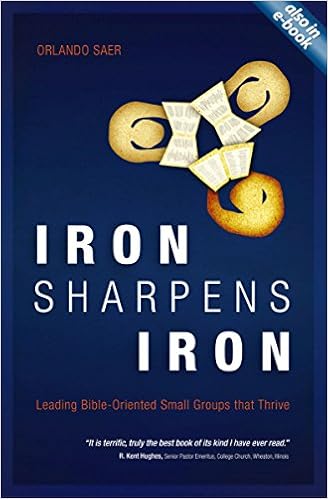 This is a great resource on how to lead a small group Bible study. The chapters are:
1) Why Small Group Bible Study?
2) Preparing for Leadership
3) Managing the Group
4) Mapping Out the Study
5) Leading the Meeting
6) Prayer, Care and Personal Nurture
The book length is manageable, and each chapter has robust content despite being quite a short
book.
Saer's thought moves from the importance of small group Bible study to consider the nitty-gritties of actually planning, managing and leading the group. He provides practical tips with clear Biblical foundations.
The book is written from experience and that comes across in the issues - dangers, challenges, realities - of small group study and is thus very helpful for anyone in such a leadership position. The book is also accessible to Christians who are not leaders - it offers a glimpse of what gospel-centred ministry looks like and I believe would help readers be better small group members.
However, the book is not a comprehensive guide to leading a Bible study and Saer offers a list of further readings at the end of the book. Nevertheless, this book is a very helpful introduction to this topic and if someone asked me for a book on how to lead a small group, I would definitely recommend this - perhaps because this is the only book I've read on the topic. Regardless, I've found it immensely beneficial, especially in how he ably crystallises the foundations of and tips for leading a good small group Bible study.
Subscribe to:
Comments (Atom)